Pope
Pius X

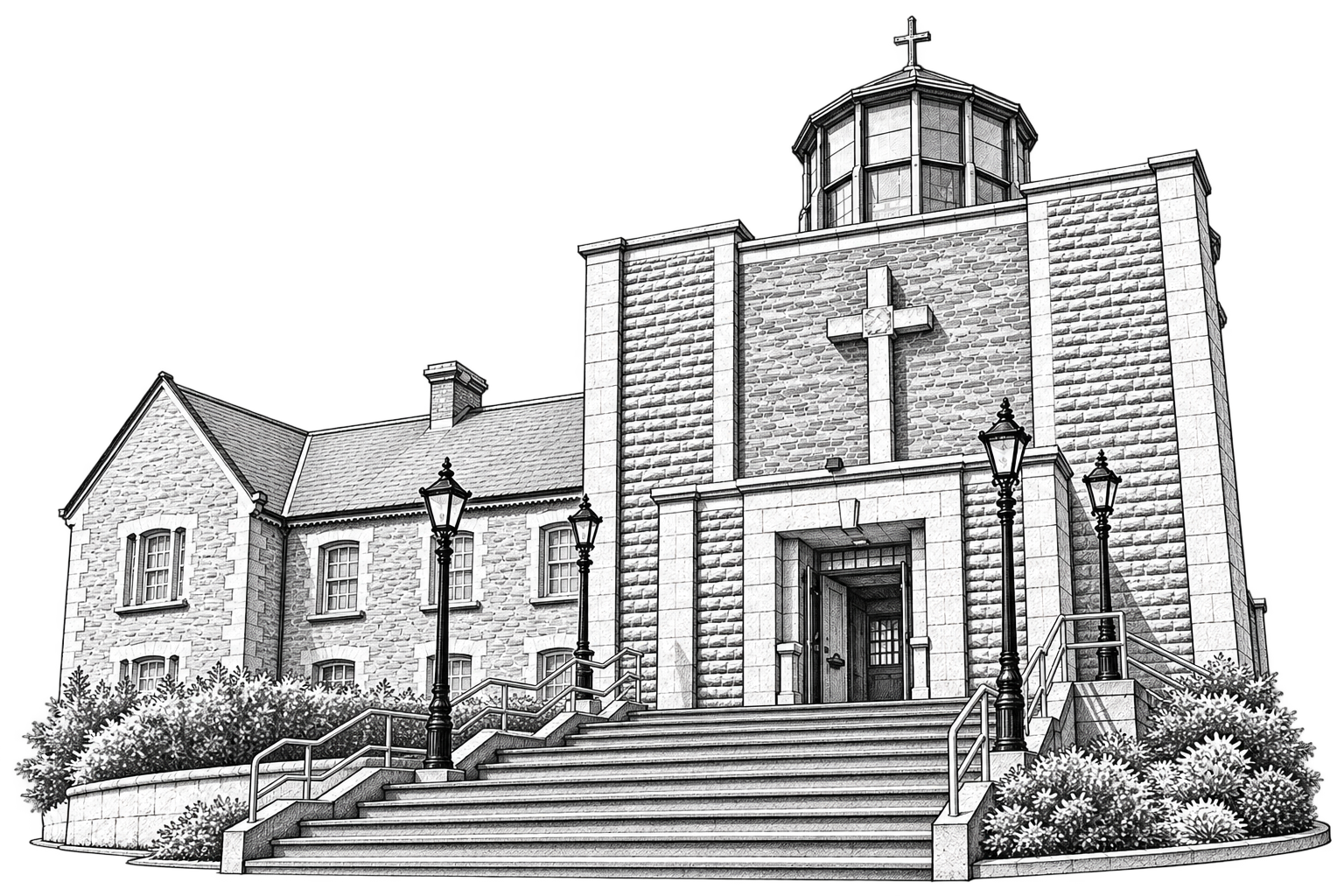
Our beautiful church
of St. Pius X is named after the Italian pope who
was canonised a few years earlier in 1954.
He was born Giuseppe Sarto into a poor Italian family
in Venice on 2nd June 1835, the second of ten children.
He died on 20th August 1914.
He became Pius X at the age
of 68, one of the 20th Century’s greatest popes.
He is best remembered for his
encouragement of frequent reception of Holy Communion.
Up until then people received Holy Communion very
occasionally. He was always mindful of his humble
origin. He said ‘I was born poor, I lived poor,
I will die poor’. He was uncomfortable and even
embarrassed with the pomp of the Papal Court. ‘Look
how they have dressed me up’ he said in tears
to an old friend. To another he said ‘This is
such a penance. I am forced to accept all these practices;
they lead me around surrounded by soldiers, like Jesus
when he was seized in Gethsemane’. Coming from
modest circumstances, he would have much preferred
a simple life. He encouraged Catholics to become more
politically involved and had a keen interest in politics
himself. He ended the veto in papal elections which
some governments presumed. He did not write any famous
encyclicals. However he spoke out against the ill
treatment of Indians in Peru and sent humanitarian
aid wherever in the world it was needed.
He had foreseen the outbreak
of the First World War. ‘I would gladly give
my life to save my people from this scourge’
he said. He died a few weeks after the war began.
‘He was a humble man
with a gentle and warm personality, a man of compassion
‘who knew the hardships of life’,”
as one historian puts it. ‘In the greatness
of his heart he wanted to comfort everyone.’
His Feast Day is August 21st.
Prayer
to St Pius X
O Lord, through
the intercession of St Pius X, bless our parish.
Keep it in your loving care.
May our homes be places of prayer and love.
May our children grow up strong in faith and hope.
May we, your people, show each other the same compassion
and kindness by which Pope Pius X lived
And in so doing may we build up this little corner
of your kingdom.
Amen

Laying of the
Foundation Stone
Feast of Christ
the King, 28th October 1956
On the Feast of Christ the
King, October 28th 1956, the foundation stone for
the new church was laid. The event featured in several
editions of the Derry Journal. As can be seen in the
photo album that follows, the church had already been
under construction for well over a year before the
service took place. On that Sunday, Moville became
the centre of the Catholic world as far as the Derry
diocese was concerned. Bishop Farren’s arrival
was greeted with the usual pomp and ceremony associated
with the time but which would be considered totally
exceptional now. The town was decorated with bunting
and flags. An F.C.A. guard of honour was inspected
by the bishop before he proceeded to the parochial
house. Accompanying the bishop were numerous priests,
several of whom were themselves natives of the parish.
Music was provided by the church choir led by choirmaster,
John McCabe and during the ceremony the choir sang
Veni Creator. Overseeing the entire event was Fr.
Dan Mc Laughlin, parish priest, the inspirational
driving force behind the whole project. A feature
of the ceremony was the handing over of the trowel
by the architect Malachy Fitzpatrick to Bishop Farren
for the formal laying of the foundation stone. The
Journal extracts and photographs that follow feature
some of the main events of that day.

The
McGuinness family and the building of St Pius X
When Moville builder and furniture
contractor John McGuinness was awarded the contract
to construct St Pius X some 54 years ago, he was presented
with the biggest challenge of his professional life.
McGuinness’s were working on the second phase
of St Finian’s Park at the time, but this was
an undertaking on a whole new scale. The new chapel
was completed in just over three years and John’s
immediate family played a big part in the project.
Here his son, Hugh McGuinness,
and daughter, Sheila Meehan, recall the building of
one of Inishowen most dramatic chapels.
In the first half of the 20th
Century, Moville’s Catholics had the Convent
Chapel as their principal place of worship. Compared
to St. Mary’s in Ballybrack, the Convent Chapel
was much smaller according to 71 year old Hugh, who
was a teenager when work began on St Pius X. “I
think the reason for wanting a new church was because
the old Convent Chapel was so small. Back then confirmation
had to be held in Ballybrack and around that time
Muff Parish joined Moville.”
For the young Hugh, his first
major job working for his father couldn’t have
been more challenging. “I was given the task
of marking out [the foundations] of the new church,
I wasn’t long out of school and my father wanted
to test me I think.” Hugh would be involved
right to the finish of the work. His sister Sheila
puts forward another reason for the desire to build
a modern chapel at the heart of the parish. “It
wasn’t really that that the existing chapel
was too small, more that it belonged to the nuns.”
Construction would not be straightforward
and, certainly, there were space restrictions on the
new building. The site was boxed in by the road in
front, the Parochial House on one side and the convent
on the other. “Fr Dan McLaughlin, a Malin man,
instigated the new church. He was the Parish Priest
and a bit of a genius, both with his hands and his
mind, and he would have been on site four days out
of the seven, while the chapel was going up”
said Hugh.
In 1954 plans for the new
church were drawn up by Derry architects Fitzpatrick
and Devine; in 1956 the foundation stone was laid.
The project required funding on an unprecedented level
in the parish. Local Curate, Fr William Rafferty,
set about filling the coffers. “A big part of
the money raised was done by Fr Rafferty. Anybody
with any connections to the parish, from Shroove to
half way up to Drung, was approached by Fr. Rafferty
for the names and addresses of friends and relatives
in America. He wrote to them and they responded very
generously.
“He started the Moville silver circle at a shilling
a week. It would have been a struggle for a lot of
people but people supported it. People in America
joined the Moville silver circle too.”
Fr Dan had played a part in
the design of the chapel in St. Columb’s College
at Bishop’s Street in Derry, so St. Pius X was
not as daunting a project as it might have otherwise
been. With its box shape and austere design, St. Pius
X differed from a lot of chapels in the country. Instead
of a spire there is a decagonal lantern, above the
gallery to let light in to the main gallery.
“It’s plain, but
then Fr Dan was a plain country man.” “Fr
Dan’s interest in architecture had a big say
in how the building would eventually look. It’s
quite a dominating building, isn’t it? The Chapel
was designed that way, to get 1000 people in it,”
adds Hugh. When the Old Convent Chapel was demolished,
some of the statues and seats went to Ballinacrae
church and some of the original seating was used in
the new church, in the main gallery, for example.
Construction in the 1950s was
a lot different from today, recalls Hugh “The
foundations were four foot wide and eight foot deep,
but there were no track diggers, it was all spade
and shovel work. The scaffolding wasn’t like
modern scaffolding either.” Two types of stones
were used for the chapel. The main walls, except the
front, are brick. For the front façade Fanad
Granite and Prehen Limestone were used.
Hugh remembers that the Altar,
also made from Fanad granite, was a special find.
“It was quite an effort to get the altar stone,
because the altar had to be in one piece. The rock
was got down at the beach in Fanad Head. The original
piece of rock was about two and a half times the size
of what it is today. It was shaped with chisel and
hammer down at our workshop in Quay Street.
A Monumental Sculptor from
Derry named Robert Bradley trained three men to help
him sculpt the altar. One of them was my brother,
John Joseph, John Farren and Manus Gillen.”
Several other intricate pieces
of stonework, such as the granite cross above the
main chapel door and the altar rails all done by hand
were also fashioned at McGuinness’ Quay Street
base. Down at the workshop there were times the men
couldn’t keep up with the demands placed upon
them for new stonework. Due to the relentless nature
of the work the sculptors would often have to run
up to Neil McDaid’s blacksmiths at Malin Road,
to have their tools tempered.
Sheila assisted her mother
Elizabeth as a secretary, although she never held
the title. “It
was a family business. My mother would have been more
of a secretary than anyone.” Sheila
and her mother filled out order sheets from the all-important
bill of quantities –the itemised list of materials,
parts, and labour required to construct the Moville
mega-structure. There were no photocopiers in those
days.
Aside from Hugh, Sheila’s
other brothers, John, Dan and Ned, were also involved
in the construction of the chapel in many capacities.
The people who worked on the chapel were bestowed
the honour of havingtheir names being placed in a
pocket in the foundation stone, but not Sheila’s
or her mother’s. “Women didn’t get
that sort of honour in those days,” she joked.
Eighteen workers in addition
to the McGuinness family toiled continuously on the
site. There were also sub-contractors on site at different
times, for example the crew that put the copper on
the roof. Work ran Monday to Friday as well as most
Saturdays up to 1pm. The project was blessed. No one
was killed over the two years of construction, although
John Joseph fell 26 feet and hurt his shoulder on
one occasion.
“My father and Fr Dan
were terribly close. They had a great respect for
each other. Fr Dan was pleased to get a local contractor
and local labour after the project was put out to
tender,” added Hugh. The men worked in all kinds
of weather, from searing heat of the summer through
to the icy winter of ’57. Through
it all John McGuinness made countless trips up and
down Moville Main Street from workshop to building
site. There were significant time pressures put on
the builders towards the end.
“It was a panic, there
was a lot of overtime towards the end. If the workshop
was busy you were in there doing joinery. If it wasn’t,
you were at the site building so you were both a builder
and a workshop joiner each week.
“The seats were the big
push at the end and the workshop went back to making
furniture, which it hadn’t done since the Second
World War due to timber shortage. We worked through
the night, for several nights before the official
opening,” said Hugh, who added that all the
woodwork for St Pius X was done at McGuinness’
workshop.
During the construction of the Chapel an army-style
hut was put up at the back of the Parochial House
so that Mass could be held in the years of construction.
The corrugated iron hut later became the town’s
youth club.
Fr Dan commissioned Derry artist
Sheila McClean (McGuinness) to paint the Stations
of the Cross, a task which she took great pride in
fulfilling. As for the naming of the church, Pius
X had just recently been declared a saint. “There
was only one other Pius X Church build in Ireland
at that time. It was in Dublin. They claimed they
were the first in Ireland to be called after the saint,
but Fr Dan wrote to them to inform them in no uncertain
terms that Moville’s chapel was the first in
Ireland to be called St. Pius X,” said Sheila.
The
chapel was opened on 26th October 1958
Sheila married Tony Meehan
in the new chapel and they were one of the first couples
to get married there. They got married in June 1960.
The feast of Christ the King
is a date that keeps cropping up when St. Pius X is
discussed. The foundation stone was laid on the feast
of Christ the King 1956 and the opening was on the
Feast of Christ the King 1958.
“Fr Dan took very ill
with cancer. They thought he would have died two weeks
before he did, yet he held out to the feast of Christ
the King October 26th 1964.
This year the Golden Jubilee
celebrations will be on the feast of Christ the King.
Today the chapel is much the
same as it was on its opening day back in 1958. Some
changes have occurred however. The Altar was originally
up against the wall at the back and the priest stood
with his back to the congregation. In addition, the
nuns’ confessional, (the top confessional on
the left-hand side which used to be accessed via a
corridor so the nuns were never seen going to confession
by the public) has been closed off. John
McGuinness died in 1973.